
How to Read Tarot Cards: A Beginner’s Guide
You can start reading tarot without memorizing 78 definitions. Begin with a clear question, a small spread, and a willingness to compare the symbols with your actual experience. This guide uses the Rider-Waite-Smith deck and treats readings as reflection rather than predictions.
Start with a question you can explore
Questions about your own choices give you more to work with than questions that require certainty about the future or another person’s thoughts. Instead of “Will I get the job?”, try “What can I prepare for my next interview?” Instead of “Do they love me?”, try “What do I need to communicate in this relationship?”
Write your question down before drawing. You can then check whether your interpretation actually addresses it, rather than changing the question to fit the cards.
Choose one card or a simple spread
One card can provide a theme for journaling. For more context, use three positions: the situation, a challenge, and a useful next step. Decide the positions before you draw so each card has a clear role.
With a physical deck, shuffle in a way that is comfortable and keeps the cards intact, then draw the number you planned. In our online reader, the deck is shuffled randomly in your browser and you select cards for the displayed positions.
Read the image, meaning, and position together
First describe what you notice in the picture without trying to predict anything. Then consult the card’s meaning. Finally, connect that meaning to its position and your question.
For example, Eight of Pentacles can point to practice and developing skill. In an interview reading’s “next step” position, you might take it as a prompt to rehearse a specific example of your work. In a “challenge” position, you might explore whether preparation has become perfectionism. The position changes the application, not the identity of the card.
Connect the cards instead of adding up definitions
Look for a useful relationship between the cards: does one describe a concern while another suggests a response? The Moon’s uncertainty beside the Magician’s resourcefulness might prompt you to identify what you can do while some information is still missing.
Record one interpretation and one alternative. This helps you notice assumptions instead of treating the first story that comes to mind as a fact. You can also decide in advance whether to use reversed meanings.
Finish with one practical reflection
Write down what fits, what does not, and one action or question worth following up. Return to the note after you have more information. A helpful reading leaves you with clearer questions and choices, rather than making the cards responsible for your decisions.
A complete three-card tarot reading example
Question: “How can I approach a new creative project?”
This is a teaching example with deliberately selected, upright cards. Before drawing your own cards, assign the positions: situation, challenge, and useful next step. These differ from a past, present, and future spread.
1 · Situation
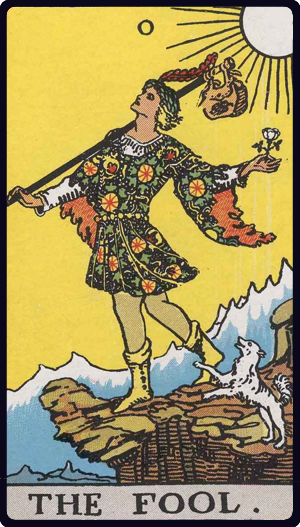
The Fool
Notice: A traveller stands near a cliff with a small bundle and a dog.
You are considering something unfamiliar. For this example, read The Fool as willingness to be a beginner, not as an instruction to abandon preparation.
Ask: What would I like to learn from this project?
2 · Challenge
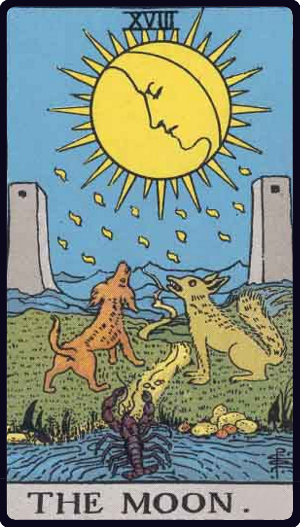
The Moon
Notice: A path runs between two towers beneath the moon.
The project still has unknowns. The Moon gives us a way to name uncertainty: perhaps you do not know how much time you can give it. It does not prove that someone is hiding information.
Ask: Which concern is a known fact, and which is an assumption?
3 · Useful next step
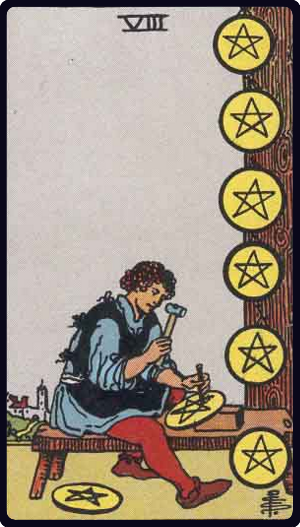
Eight of Pentacles
Notice: A craftsperson works on one pentacle while completed pieces are displayed nearby.
Practice turns the broad wish to begin into something manageable. In this position, the card suggests choosing one skill and giving it a focused session before judging the entire project.
Ask: What could I practice for 20 minutes this week?
Read the three cards as one story
The Fool supplies the willingness to begin, The Moon names the uncertainty, and Eight of Pentacles offers a response: learn through a small, repeatable practice. Together, they suggest exploring the project without demanding certainty before the first attempt.
Example journal note: “I want to start sketching, but I assume I need expensive materials. I will use the pencil and paper I already have for one 20-minute session, then note what I enjoyed and what I need to learn.”
Check another interpretation: You might already be experimenting and need a clearer routine. Compare both readings with your actual situation. Nothing in these cards establishes whether the project will succeed.
For another way to assign three positions, try the past, present, and future tarot reading.